


Perhaps the best role model is St. Francis of Assisi...
It happened again. A friend, speaking of his brother’s recent death, said, “I know the moment of death, the soul leaves the body, and it [the body] is just useless scrap.” My friend is a lifelong faithful orthodox Lutheran. Every Sunday, he recites, “I believe in the resurrection of the Body.” But his real belief is anchored in the Greek pagan philosophers.
“The Hellenic culture into which Christianity entered after Pentecost was dominated by neo-platonism, a worldview that fundamentally opposed spiritual and material reality. For the Greco-Roman world, the spirit, the soul, was essentially good, but the physical, the body, was the source of temptation, delusion and evil…Classical society had assumed that death was the liberation of the good soul from the physical, and therefore evil, prison, the body” (in Michael Oleksa, “Orthodox Alaska,” p.48).
All these centuries later, the message of Resurrection has not overcome Hellenic pagan beliefs. Much of the history of Christian thought is a documentation of the seemingly endless struggle to replace Plato with Jesus’ teachings. “He [Jesus] was far removed from philosophies which despised the body, matter and the things of the world,” notes Pope Francis, “Such unhealthy dualisms, nonetheless, left a mark on certain Christian thinkers in the course of history and disfigured the Gospel” (“Laudato Si,” #98). Some of those thinkers still have an outsized influence in shaping Christian thought.
The power of this pervasive and pivotal heresy is immense, because it is so foundational to a worldview. The defining Ecumenical Councils of the fourth and fifth centuries were epic battles to combat the heresy in its Christological aspects. The Arian view was that Jesus was a creation of God’s at some point, like the rest of us. This is the belief, of course, of Islam and Judaism. Modern liberal Protestant theologians who deny the Incarnation are also in this camp. So are the many Christians who speak instinctively of “God and Jesus” as if Jesus were a separate being apart from God. Many of the latter group might be surprised they have rejected a doctrine at the core of Christianity, but nevertheless, they have. The heresy also has an impact on how we view the environment. “In the Christian understanding of the world, the destiny of all creation is bound up with the mystery of Christ present from the beginning,” (Pope Francis again, “Laudato Si,”#99). John begins his Gospel stating “In the beginning was the Word,” i.e the Logos of Jesus Christ, who has been made flesh and dwelt among us. If Christ is a person of the Godhead, uncreated, present eternally from before time began, he is an active participation in the creation. The platonic notion that the material creation is evil is therefore rejected by Christians, since Christ does not create evil. Genesis notes on the contrary that when God had created the planet, enumerating mostly the material things he made, he looked and saw that it was good (Genesis 1:31).
Both modern capitalism and the communism of the former Soviet Union sees the planet as an environment to exploit and conquer until its resources are exhausted. This view harmonizes well with the neo-platonic concept. The Christians who hold this belief interpret the dominion over the earth gifted them by God (Gen.1:26) as a license to plunder and subdue the environment. If the material world is evil, the sooner it is done, the better.
But God, who we confess as Trinity, has always included the Son. Jesus states, “Before Abraham was, I am” (I am=Yahweh, John 8:58). Thus, Jesus participates in the creation, which God sees as good. Dominion then means a benevolent rule by mankind, offered to God according to our mandated vocation as kings and priests (1 Peter 2:9, Revelation 5:10), in accordance with his will. Our job is to nurture and care for the planet, not exploit and wreck it. It includes how we care for earth’s creatures, including our fellow humans. Should we not be leaders in the environmental movements? We as Christians know the full value of protecting the environment and even the reason for its existence. But if we are infected with the platonic dualism, we cannot proclaim the Gospel that “the earth is the Lord’s.”
The impact of the heresy continues. Paul tells us our bodies, for example, are temples of God. But neo-platonic doctrine leads to having contempt and shame in regard to your body, to an enforced priestly celibacy in the Roman Church with terrible side effects, and ultimately, as mentioned above, to a denial of the resurrection of the body. It causes many to look down on “secular” occupations as being, at best, a lessor calling when many of these vocations are stewarding God’s earth and God’s needy people.
Given the almost ubiquitous presence of this heresy and the dimensions of the disasters it causes, is there a way to replace it with the Gospel of grace? There is a time-tested solution, which has worked in eastern Christianity, although it changes the nature of evangelism. In our cultural context, it is not that most people have no idea of Christianity, as some isolated tribe might. Rather what they know is often misinformation, fake news. Therefore, they must first be cleansed of what they think Christianity is, before the Gospel can be proclaimed.
It is an intense and lengthy process. Begin with the definition of evangelism by Bishop Anastasios (Yannoulatos). First, it is “the incarnation of the logos of God into the language and customs of a country.” Second, it means “the growth of an indigenous Church which will sanctify and endorse the people’s personality” (“St. Vladimir’s Theological Quarterly,” vol.3/ 1964, p.144-145). This was successfully done in much of eastern Europe and the multiple indigenous peoples of Siberia and Alaska.
The United States is a bigger challenge. The Puritan heritage and the superficial selfdesignation as a “Judeo-Christian” society thwarts the introduction of the Gospel. In the reality of a living culture, it is possible for the culture to permeate the Church, instead of the other way around. An example might be, in the political and social polarization happening, that the Church is dividing into the same polarization, reflecting the secular divisions. If Christianity were instead permeating the culture, the Gospel message of love, forgiveness, stewardship of the earth and caring for your enemy would be bringing people together to seek common solutions to our problems and showing respect for others and their opinions.
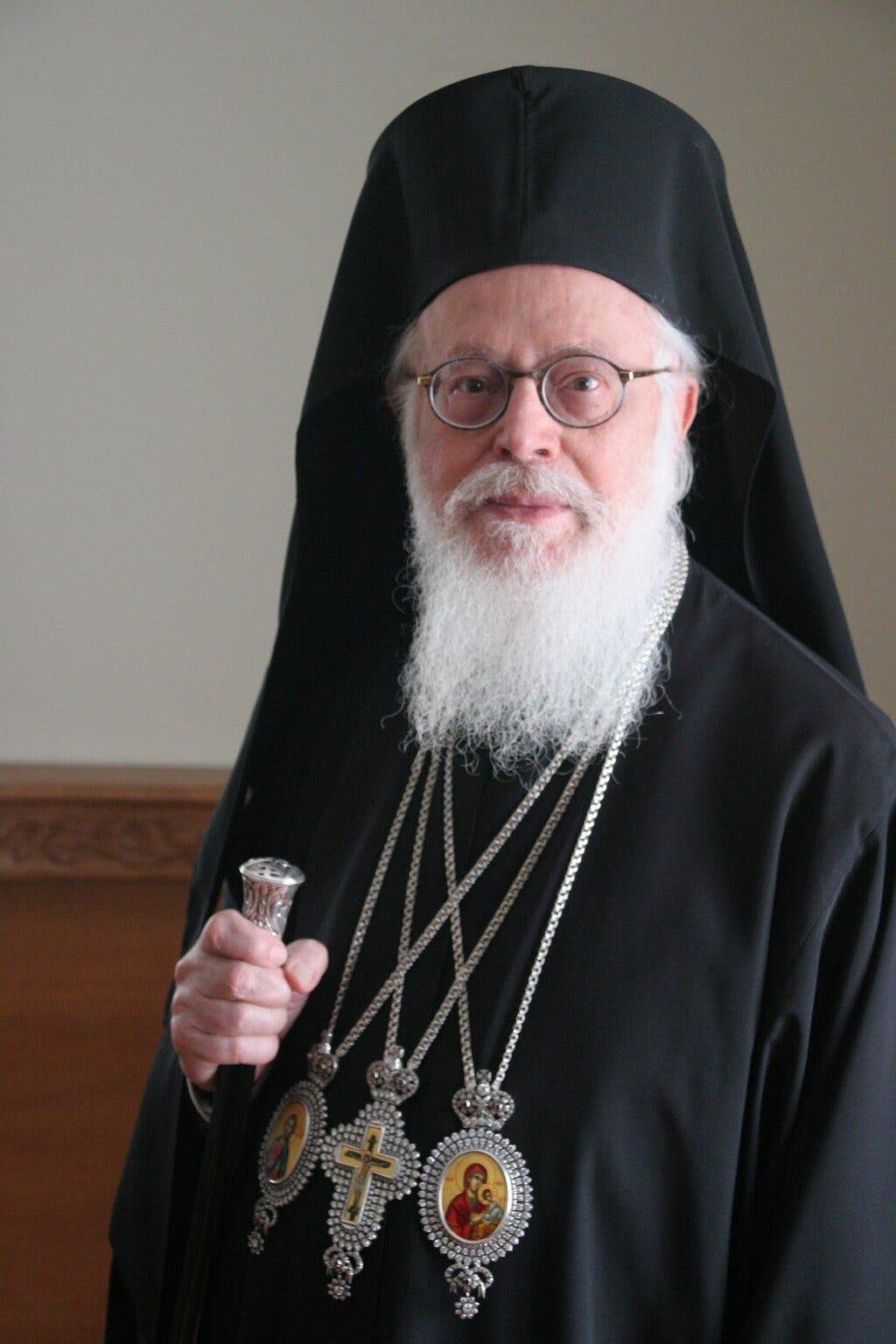

Permeating the culture is a big undertaking, with no guarantee of success. Nevertheless, to apply the wisdom of Bishop Anastasios is the only way I know to correct the heresy and counter its many side effects in our world today. Perhaps the best role model is St. Francis of Assisi, who was very much counter-culture to the society around him, but went about teaching many how to revise their lives and their culture in a way which saw the natural world in reality, as God’s good creation, and walked with humility to lead people into a better way than following their poisonous political passions and social viewpoints dripping with anger, hostility and disdain for others. Some humorist commented (Ambrose Bearse perhaps?), “It’s a shame for America to now reject Christianity without ever having tried it.” But maybe if people reject the parody which now presents itself as Christianity, it is our opportunity to fill the space with the Gospel message of God’s love for us and for the creation.
I find your critique compelling. However, your landing zone seems to be too… disjointed.
How does the notion of a Francis Option (RC) fit within a Christendom Evangelization (EO) and represent the Gospel of Grace (Prot)???
Again, your critiques are compelling — inspiring, even. Yet, I don’t think your solution is similarly compelling. It seems to come across as a veiled desire to return to Christendom, and in a way that requires too much institutional power.
I think there is much spiritual purpose in moving past Christendom. I am glad it’s gone. I don’t want to return to pre-Christian paganism either — but I don’t believe that’s where we are going. Unfortunately, postmodernism has ruined it all and left us to pick up the pieces.
And, to me, the hearkening back to Christendom will not save us who are trying to find our way within the ruins of it. We are stuck in post-truth, post-institution, post-liberal societies which cannot provide any support to such a grand institutional move, and, as far as I can see, will do nothing but undermine such a move toward cultural influence. (Not too mention the direct tie between cultural influence and cultural power that has resulted in the Nationalism of EO churches)
I think a better foundation of where we could go is an idea from Ian Cron’s novel Chasing Francis: “To the spiritual neglect, consumerism, and complicity that filled the church, Saint Francis offered a corrective… it was the *communal example* of Francis and his followers, not polished rhetoric, which provided challenge for the church.” I would add to this the historical fact that Francis was a preacher! I think this is a better “starter pack” of how we can be a μάρτυς/witness in today’s society, rather than exerting cultural influence.
Maybe a more compelling Christianity comes not from cultural influence that consecrates a country, but a compelling community telling the most compelling story to anyone who will listen! :)
PS — thank you so much for your thoughts on Platonism. I believe if we could remove neo-platonic thought from our churches, we could effectively erect a barrier to hold back Gnostic tendencies (such as the Evangelical tendency to believe that faith is about escaping to heaven when you die rather than seeing it as an existential reality to live in by which God brings heaven to earth).
I am so on board with this. My wife and I have been talking a lot over the last few weeks about this exact problem (especially within reformed/baptistic contexts where a lot of our friends are).
We are trying to figure out how exactly to define “what is Christianity, anyway?” at different levels—for both American Christians, and for American unbelievers, and we are right there with you in all of this.